
How Bench Warrants Work in Austin County
“Bench warrant” is common public language for court process after a missed appearance or another unmet court requirement. Austin County dockets may use FTA, capias, alias capias, or another term. A missed date does not create the same process in every case, and the court file controls what happened.
Start with the court name and citation or cause number. A city ordinance case belongs with its municipal court; a county citation belongs with the named JP; county and felony matters follow their own court and clerk routes.
Austin County Bench Warrant Reset Steps
Wallis Municipal Court asks for a reset or continuance no later than three business days before the appearance date. Its page says a missed appearance may bring a new FTA charge, additional fine, and court costs. That is Wallis’s posted instruction, not a countywide rule.
The Wallis court page also provides a virtual-hearing link and says some matters still require an appearance before the judge. Ask the court whether the specific citation can be reset or handled remotely, and verify the current court contact because city and state directory entries differ.
Wallis Municipal Court instructions are a local example of why the issuing court matters.
Bench Warrant Issuance in Austin County
The court that set a required date or order decides what process follows a failure to appear. The docket may show an FTA, a capias, a reset, or another event. The Sheriff or police may execute process, but the issuing court controls the case, the next appearance, and any recall.
Use the notice and the Texas court directory to identify the proper court when the paperwork is unclear. Do not assume a county portal includes every city or JP case.
Austin County Sealy Warrant Payment Plans
Sealy Municipal Court’s city-linked payment page says partial payments on active warrants require a Payment Plan application. The page gives a preliminary due date within 30 days after the court emails the application and identifies case types that cannot be paid through that vendor.
This instruction belongs to Sealy Municipal Court. A Sealy address can also appear on a JP3 citation, and JP3 uses a different payment route described on its official JP3 page. Read the court line on the paper before paying and ask whether an appearance or other step remains.
Payment is not the same as a court recall. Keep the receipt and ask the court what docket entry will confirm resolution.
How Bench and Arrest Warrants Differ
A bench warrant usually follows a court event such as a missed appearance. An arrest warrant is based on the statutory probable-cause process for an alleged offense. Both involve a court or magistrate and an authorized officer, but the trigger and response differ. The companion arrest warrant lookup explains the Chapter 15 route.
| Feature | Bench Warrant | Arrest Warrant |
|---|---|---|
| Trigger | Missed court appearance or unmet court order. | Sworn complaint and probable-cause process. |
| Issuing role | The court that set the required appearance. | A magistrate or court with authority to issue it. |
| Case context | An existing matter with a missed obligation. | An alleged offense or other statutory basis. |
| Next step | Ask about reset, appearance, payment, bond, or recall. | Ask about counsel, bond, appearance, or court process. |
Austin County Capias Pro Fine Safeguards
A capias pro fine is post-judgment process used in a justice or municipal court. Texas Code of Criminal Procedure Chapter 45A requires judgment or sentence information and sets safeguards for issuance when a person has not satisfied the judgment. It is not a synonym for every arrest warrant.
The Legislature’s Chapter 45A text addresses an undue-hardship hearing and a good-faith effort before certain capias-pro-fine process. The court decides which rule applies to a case.
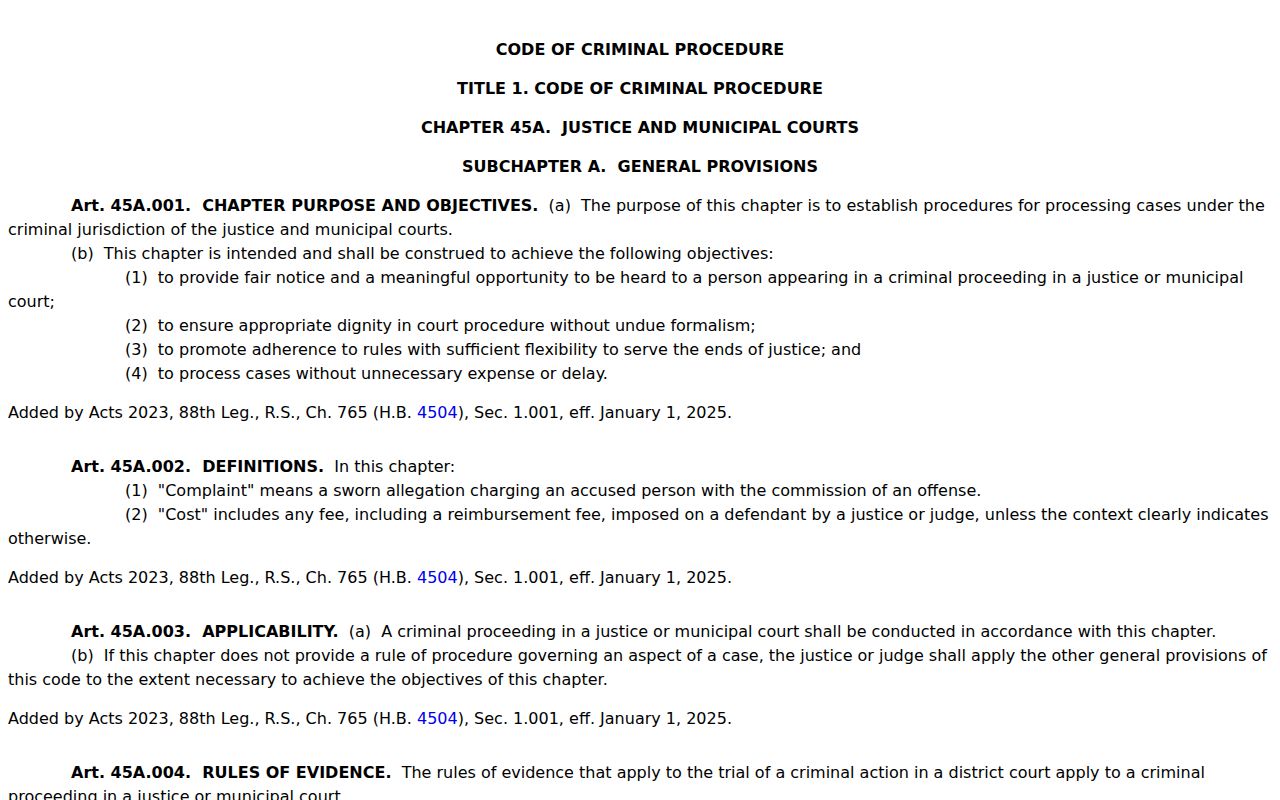
This image points to the statute’s capias section. Ask the issuing JP or municipal court what hearing, payment, or appearance it requires.
The separate Chapter 15 warrant statute covers arrest warrants and summonses.
Chapter 15 and Chapter 45A cover different process, so use the court’s exact term rather than a broad label.
Clearing a Bench Warrant in Austin County
Confirm the court and process type before paying or appearing. The options depend on the underlying case. A lawyer can discuss a motion to recall or quash and help plan an appearance. Do not assume a payment receipt by itself closes an FTA or removes court process.
- Call the court named on the citation or case notice and ask whether the process is active.
- Ask whether a reset, scheduled appearance, attorney appearance, payment plan, bond, or hardship hearing is available.
- Follow the court’s payment or appearance instructions; do not use another precinct’s or city’s payment page.
- Keep the receipt, reset notice, recall order, or docket entry and ask how the court confirms the process is cleared.
Caution: Do not ignore a court notice or assume an old entry expired; contact the issuing court and ask what action is required now.
Austin County JP Warrant Routing
Austin County has four JP courts, each with a separate office and phone. Use the precinct printed on the citation; a nearby city does not reliably identify which JP owns the case.
| Court | Office | Published phone | Local note |
|---|---|---|---|
| JP1 | Bellville | 979-865-9171 | Separate from Bellville Municipal Court. |
| JP2 | Industry | 979-357-4477 | Use the precinct on the citation. |
| JP3 | Sealy | 979-885-3195 | Own payment and reset instructions. |
| JP4 | Wallis | 979-478-6723 | Official page lists a Friday closure. |
The county JP directory supplies the current routing starting point. Call before travel because posted hours and payment methods vary.
Austin County Warrant Payments Need Confirmation
Austin County’s traffic courtesy letter and JP3 payment PDF describe different transactions. The county letter says no partial payments in its described process; JP3 lists a $6.50 vendor fee and no personal checks. Neither detail is a universal warrant-clearance rule.
Ask the issuing court whether money is owed, whether an appearance remains required, and what written entry will show that a warrant or capias has been recalled. If the issue is a DPS license hold, verify that status separately after the court acts.
Note: A payment vendor handles the transaction; the issuing court controls the docket and confirms the process outcome.
Austin County Courts That Issue Bench Warrants
The court that ordered the appearance controls a bench-warrant question. Municipal courts handle their own city ordinance and Class C matters. JP1 through JP4 keep precinct dockets. County Court and County Court at Law handle county-level matters, while the District Clerk routes felony cases after indictment.
If the paperwork does not name the court, use the official directory or the county overview’s Austin County court-routing table. Ask the clerk which process is in the docket and what step will produce written confirmation.